
India's exports in April jumped nearly three-fold to USD 30.63 billion from USD 10.36 billion in the same month last year, according to government data released on Friday.

The country's exports dipped 8.74 per cent to $23.52 billion in November on account of contraction in shipments of key sectors like petroleum, engineering, chemicals and gems and jewellery, official data showed on Tuesday. Trade deficit during the month narrowed to $9.87 billion as imports too declined by 13.32 per cent to $33.39 billion.

The primary and immediate impact of a depreciating rupee is on the importers who will have to shell out more for the same quantity and price. However, it is a boon for the exporters as they receive more rupees in exchange for dollars. The rupee depreciation has wiped away some of the gains that would have accrued to India from international oil and fuel prices dropping to pre-Ukraine war levels.

This year, India bought 27.7% of the gold exported by Switzerland; in Jan, this was only 15%.

Against the Reserve Bank of India's (RBI's) projection of 7.1 per cent, India's first quarter (Q1) 2024-25 (FY25) gross domestic product (GDP) growth came in at 6.7 per cent. This is in line with market expectations and significantly lower than the 7.8 per cent recorded in the fourth quarter (Q4) 2023-24 (FY24) and 8.2 per cent in Q1FY24. The quarter witnessed decreased government consumption and investment spending due to the parliamentary election.

Exports of petroleum products, chemicals, pharmaceuticals, gems and jewellery, and engineering goods registered a positive growth.
According to data released by the commerce and industry ministry, exports stood at $25.01 billion in the month. The fall is only the second time exports contracted in the past year.

Export sectors that showed positive growth last month included chemical, iron ore, electronics, marine products and pharmaceuticals. Decline in overall imports, including oil and gold, led to narrowing of trade deficit.

India's services exports in December stood at $12.87 billion, slightly higher from a month earlier, according to the Reserve Bank data released.

Iran is India's largest importer of tea in value terms while in terms of volume, it is the second largest after Russia

Services exports in September this year were worth $12.29 billion, marginally down from the previous month, according to the Reserve Bank data.
The rupee weakened by 14 paise to close at a new lifetime low of 79.59 against the US dollar on Tuesday as a strong greenback overseas and persistent foreign fund outflows continued to weigh on investor sentiment. This comes a day after the RBI announced measures for international trade settlement in rupees. At the interbank forex market, the local unit opened weak at 79.55 against the greenback and witnessed an intra-day high of 79.53 and a low of 79.66.

Overall gross import of rough diamonds between April to November 2019 has shown a decline of 17.24 per cent to $8.55 billion from $10.34 billion registered during April to November 2018. This is one of sharpest fall in import of diamond in India in last one decade.

The total exports from services in November 2012 was at $12.03 billion, as per RBI data.

Gold import this financial year is estimated at 945 tonnes.
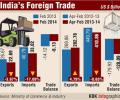
For the April-February period, exports were up 4.79 per cent to $282.7 billion, according to data released by the Ministry of Commerce and Industry on Tuesday.

This period of strong growth not only offers opportunities but also calls for strategic considerations to ensure sustainable development and equitable prosperity in the years to come, suggests Sujan Hajra.

Six decades and more later, we are now captives of our identities. Every poll is based on elaborate calculations of electability of candidates on the basis of their castes and other narrow definers. That, along with voter promiscuity, is what defines our political culture, which remains stubbornly resistant to any change, asserts Shreekant Sambrani.

The rising dependence on discounted crude oil has resulted in India's trade deficit with Russia hitting the second-highest place last year, after China, reveals Department of Commerce data. From April through January 2022-23 (FY23), India's maximum trade deficit was with China, at $71.58 billion. This was followed by Russia, where the deficit expanded sevenfold - from $4.86 billion in April-January of 2021-22 (FY22) to $34.79 billion during the same period in FY23.

The fall in exports of gems and jewellery exports is mainly because of shortage of raw-material for jewellery manufacturing.

The country's merchandise deficit narrowed to $9.2 billion in November, but exports growth eased to 5.9 percent from 13.5 percent in October, government data showed.

India's exports dipped after a gap of four months in March but finished 2017-18 with a healthy rise of 9.78 per cent to $302.84 billion.

If government statistics are at variance with private data flow, chances are high that the latter presents a picture closer to reality.

Out of these, no balance has been found in case of 289 accounts

The sector employs around 1 million skilled and unskilled workers directly and indirectly and decline in exports is a major worry for participants in the value chain.

The growth in imports was led by product categories such as diagnostic items, ultra-sonogram machines, MRI and ECG apparatus, syringes with needles, suture needles, digital thermometers, malaria diagnostic kits, and hearing aids.

The rupee breached the 80-mark against the dollar on Tuesday. The steady depreciation in the value of the rupee against the US dollar is likely to prove expensive for corporate India. The listed companies' revenue expenses in foreign currency or imports exceed their export revenues or revenue earnings in forex. In their latest financial year, BSE500 companies, excluding banks and non-banking finance companies and insurance (BFSI), reported combined forex expenses of Rs 12.31 trillion against forex earnings of around Rs 10 trillion.

Growth in the eight core sectors jumped to 8.5% in April, due to a sharp pick-up in refinery products and a commensurate rise in electricity generation.
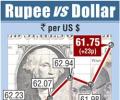
In Hong Kong market, the dollar fell against Japanese yen in early trade after the release of a set of stronger- than-expected economic data.

Russian oil supplies to India will continue to flow unhindered and suppliers will come up with ways to sidestep secondary sanctions, a Russian official told Business Standard.

'If because of El Nino, the monsoon is affected adversely in the current year, naturally it will affect income projections and consequently Budget numbers.'

Capital expenditure by Indian companies is likely to see an uptick in the upcoming quarters as capacity utilisation has surpassed the critical threshold of 75 per cent, and numerous companies have deleveraged their balance sheets, according to analysts. The first quarter of the current financial year has shown improved profitability, driven by a decrease in input prices. This, according to analysts at Care Ratings, should stimulate a revival in the private capex cycle.

At 12-15 tonnes, the imports in September are estimated to be much lower than in the same month last year.

The International Monetary Fund (IMF) warned on Tuesday that India's general government debt (comprising both central and state government debt) could exceed 100 per cent of gross domestic product (GDP) in the medium term. It also cautioned that long-term debt sustainability risks are high due to the significant investment required to meet India's climate change mitigation targets. The Indian government, however, disagreed, arguing that risks from sovereign debt are extremely limited as it is predominantly denominated in domestic currency.

India's appetite for imported crude oil may wane in fiscal year (FY) 2023 from record levels in pre-pandemic 2019-20 fiscal as higher oil prices, a spillover from the conflict in Ukraine, and increasing use of biofuels affect domestic demand for petroleum products. Brent crude surged to a nine-year high, shy of a July 2008 record $147.50 a barrel, before declining to around $100 a barrel - but the volatility in commodity rates will slow global economic growth and use of fuels. Demand for all oil products may grow at only 2-3 per cent in FY23, slower than the current fiscal and nearly half the 5.5 per cent growth estimated by the petroleum ministry, according to industry officials.

'Rhetoric and chest-thumping are running high on India's recent growth record.'
'But will the giant waves developing elsewhere allow us to sail smoothly into fair winds?' asks Debashis Basu.

'80% of the rural and urban population don't have enough purchasing power.'

The rule required firms to mandatorily export 20 per cent of the gold they had imported.

Modi sees export-led growth one of the best ways to create jobs.
The Indian rupee may remain under depreciation pressure on account of plateauing of exports and subsequent widening of the current account deficit, said the Economic Survey 2022-23 tabled in Parliament on Tuesday. It said the "risks to the current account balance stem from multiple sources". The country's current account deficit (CAD) widened to 4.4 per cent of the GDP in the quarter ended September from 2.2 per cent in April-June due to higher trade gap, as per latest data of the Reserve Bank of India.
 © 2026 Rediff.com - Advertise with us - Disclaimer - Privacy Policy - Sitemap - Feedback - About us - Terms of use - Grievances